
为什么在希腊毕业没有学位帽,还穿同款学位服?Why Do Greek University Graduates Lack Graduation Caps and Wear Identical Academic Gowns?
又到了一年一度的毕业季。当朋友圈被各种抛向空中的“方形学士帽”刷屏时,你是否知道,在西方文明的发源地——希腊,大学毕业生们却呈现出一幅截然不同的景象:没有学士帽,所有学位的长袍一模一样,而仪式的核心环节,竟是一场神圣的“宣誓”。
今天,就让我们走进希腊的高等教育殿堂,探寻这种独特传统背后的底层逻辑,并认识在爱琴海畔深耕戏剧教育的中国“破壁人”。
01 毕业不看衣服不戴学位帽
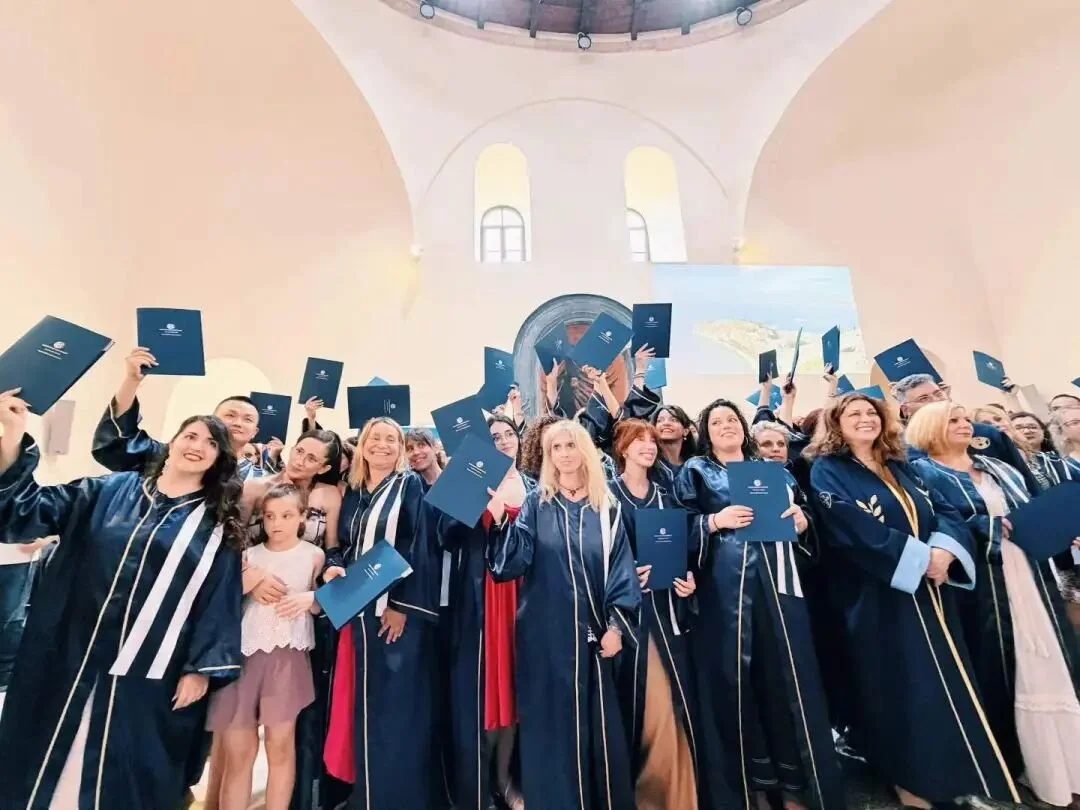
在英美体系中,学士、硕士和博士的学位服有着极其严格的等级区分。但在希腊的公立大学,无论你是刚刚完成四年的本科生,还是经历了数年冷板凳煎熬的博士,毕业典礼上的长袍(Τήβεννος)通常是同一款。甚至学校干脆不发帽子。
这并非希腊人“不讲究”,而是源于一种极其深厚的古典哲学:在真理与公共责任面前,学者生而平等。在希腊的教育哲学中,无论是刚取得基础学位的本科生,还是在某一领域深耕的博士,在追求真理的道路上,大家都共享同一个身份——“学者”(Scholar)。统一的长袍,正是这种学术平等精神的视觉体现。
我们今天常见的方形学士帽,起源于中世纪西欧罗马天主教神职人员佩戴的“双角帽”或“四角帽”(Biretta)。但是在希腊没有中世纪行会式的阶级划分,没有繁复的天鹅绒边修饰。在部分历史悠久的大学或特定院系(如雅典大学、亚里士多德大学),学校会发给毕业生一件简单的学术长袍(Tivennos,颜色通常代表不同的学科),套在正装外面,但绝对不配帽子。
希腊大学的长袍 (Τήβεννος) 在设计理念上,更倾向于致敬古希腊和古罗马时期的托加长袍(Toga)。在古典时代,长袍是自由公民的象征。
仪式结束后,有些亲友们会为毕业生戴上一顶用月桂树枝编织的“桂冠”——这是古希腊象征胜利与最高荣誉的图腾,远比一顶学士帽来得浪漫与庄重。
02 希腊大学毕业要宣誓
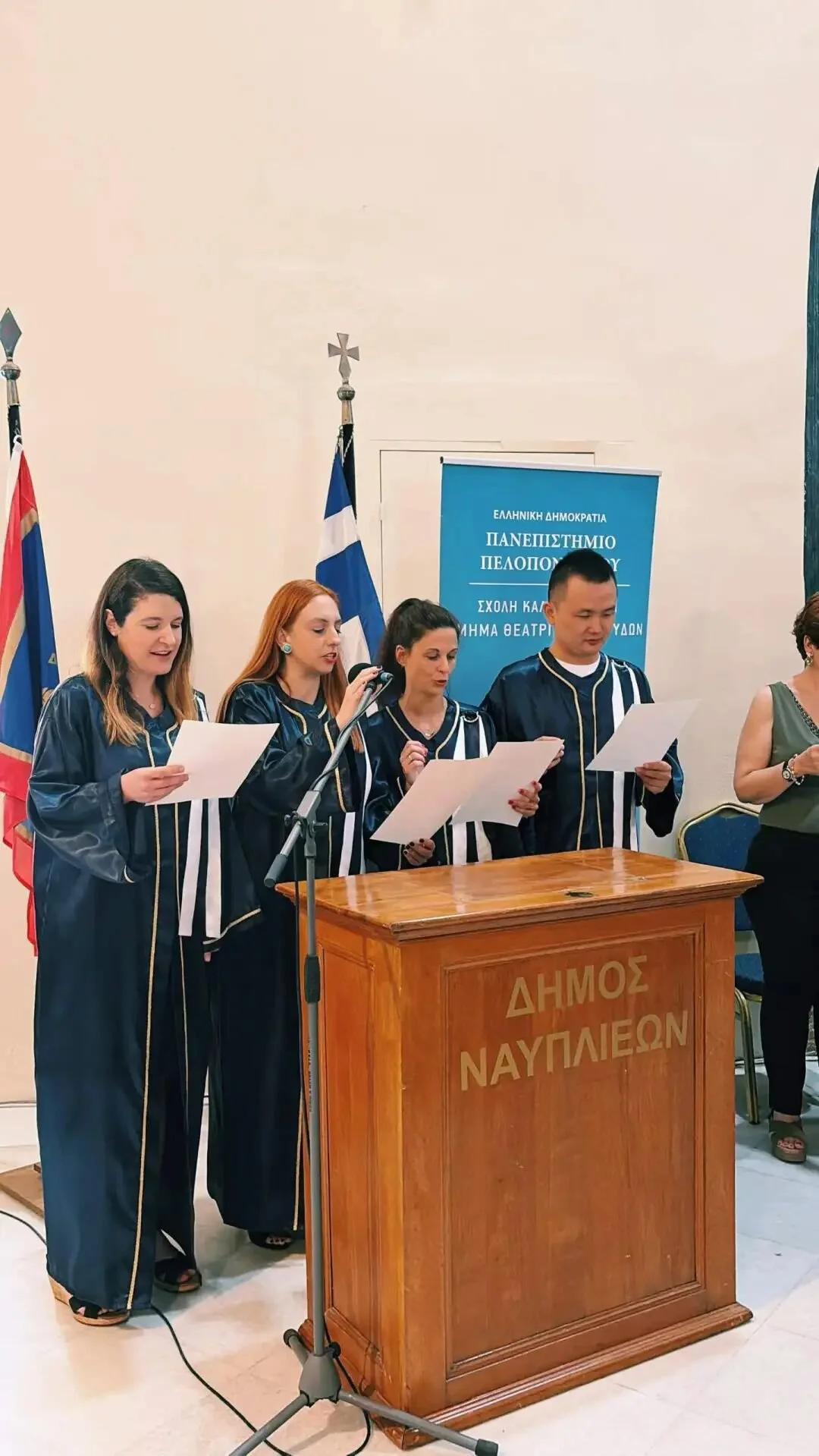
希腊的毕业典礼不叫 Graduation,而被称为Ορκωμοσία (Orkomosia),直译为“宣誓仪式”。在希腊的教育哲学中,毕业不是获得一纸证书的交易,而是一场庄严的社会契约仪式。无论你是学医、学戏剧还是学工程,都必须(选择以宗教或世俗个人荣誉的名义)公开宣誓:承诺将所学的知识用于造福社会,捍卫人类尊严。
这种将“宣誓”置于毕业绝对核心地位的做法,主要源于希腊对知识、道德和公民责任的深刻历史认知:
古希腊传统的精神延续
宣誓的传统深深扎根于古希腊文化。最著名的例子是《希波克拉底誓言》(Hippocratic Oath),它确立了医学伦理的基石;另一个是《雅典青年誓言》(Ephebic Oath),古雅典青年在完成军事和公民训练后,必须宣誓保卫城邦、尊重法律。
现代希腊大学的宣誓正是这种精神的现代回响。它传达了一个核心理念:知识和技能必须受到道德的约束。掌握了专业知识的人,就像掌握了武器的青年,必须向共同体(城邦/社会)承诺,不会将这种力量用于破坏。
知识的“社会契约”与公共属性
希腊《宪法》规定公立高等教育是完全免费的。这意味着一个大学生的培养,是由国家和全体纳税人共同承担的。
因此,毕业宣誓本质上是一种感恩与反哺的社会契约。誓词中通常会明确提到,毕业生承诺将所学的科学与艺术用于造福人类,服务社会,而不是仅仅为了个人的私利。这是一种向社会“交付答卷”的仪式感。
强调“伦理”先于“学术”
在希腊的学术传统中,教育不仅是传授技能,更是关于“人”的塑造(即古希腊的 Paideia 理念)。宣誓仪式强调了职业伦理。无论你是学戏剧、教育、工程还是医学,誓词都会要求毕业生在未来的职业生涯中坚守真理、保持正直、捍卫人类的尊严。它提醒学者,没有道德内核的学术是空洞甚至危险的。
希腊大学的毕业宣誓,是对学者这一身份的确认。它剥离了浮夸的外在装饰,用最古老的语言力量,要求每一个即将走向社会的年轻人直面内心的责任与良知。
03 “宽进严出”的硬核学术炼狱
能戴上这顶月桂冠,绝非易事。希腊《宪法》保障了公立高等教育的完全免费,但也铸就了其极度严谨的“宽进严出”体系。
五/六年制的“王炸”:
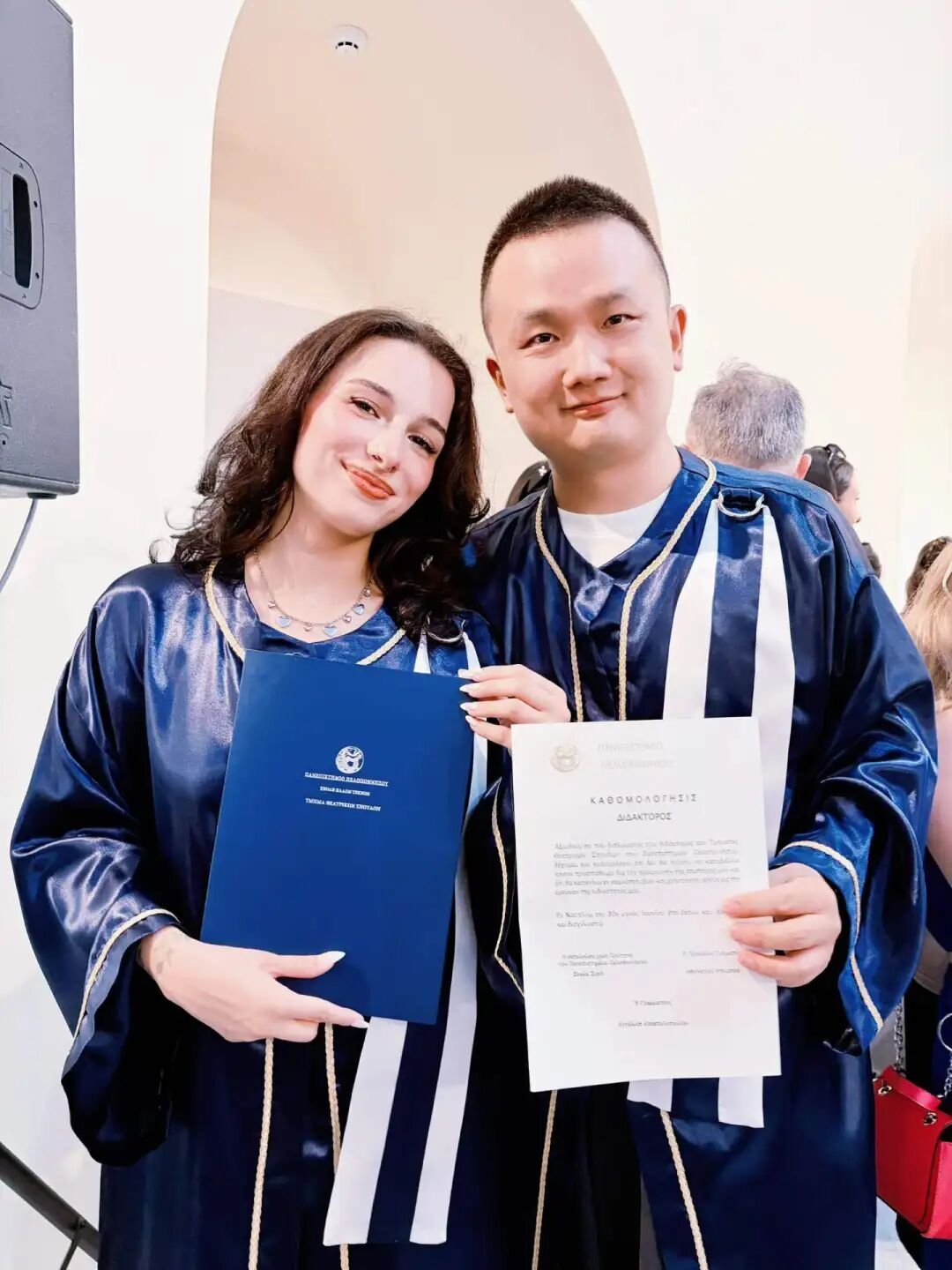
在希腊,部分工程、美术以及戏剧教育类专业,本科一读就是5年(医学6年)。毕业直接授予“整合型硕士”(Integrated Master),含金量极高。
不设限的博士炼狱:
希腊的博士培养完全是研究导向,由三位导师共同指导。没有大课,只有严苛的导师负责制。博士毕业没有“走过场”,必须面对由7名教授组成的公开答辩(Public Defense)。过得了这一关,你才算真正踏入了学术同行的殿堂。
04 跨文化戏剧里的中国“破壁人”
在这条极其硬核的学术之路上,有一个极为特殊且稀少的群体:在希腊攻读戏剧博士的中国学者。其中,将希腊戏剧教育与中国本土基础教育实践深度融合的缪斌,正是这个群体中最具代表性的探索者,他在希腊与中国戏剧教育之间,构建了一个非常完整且深度的个人生态。
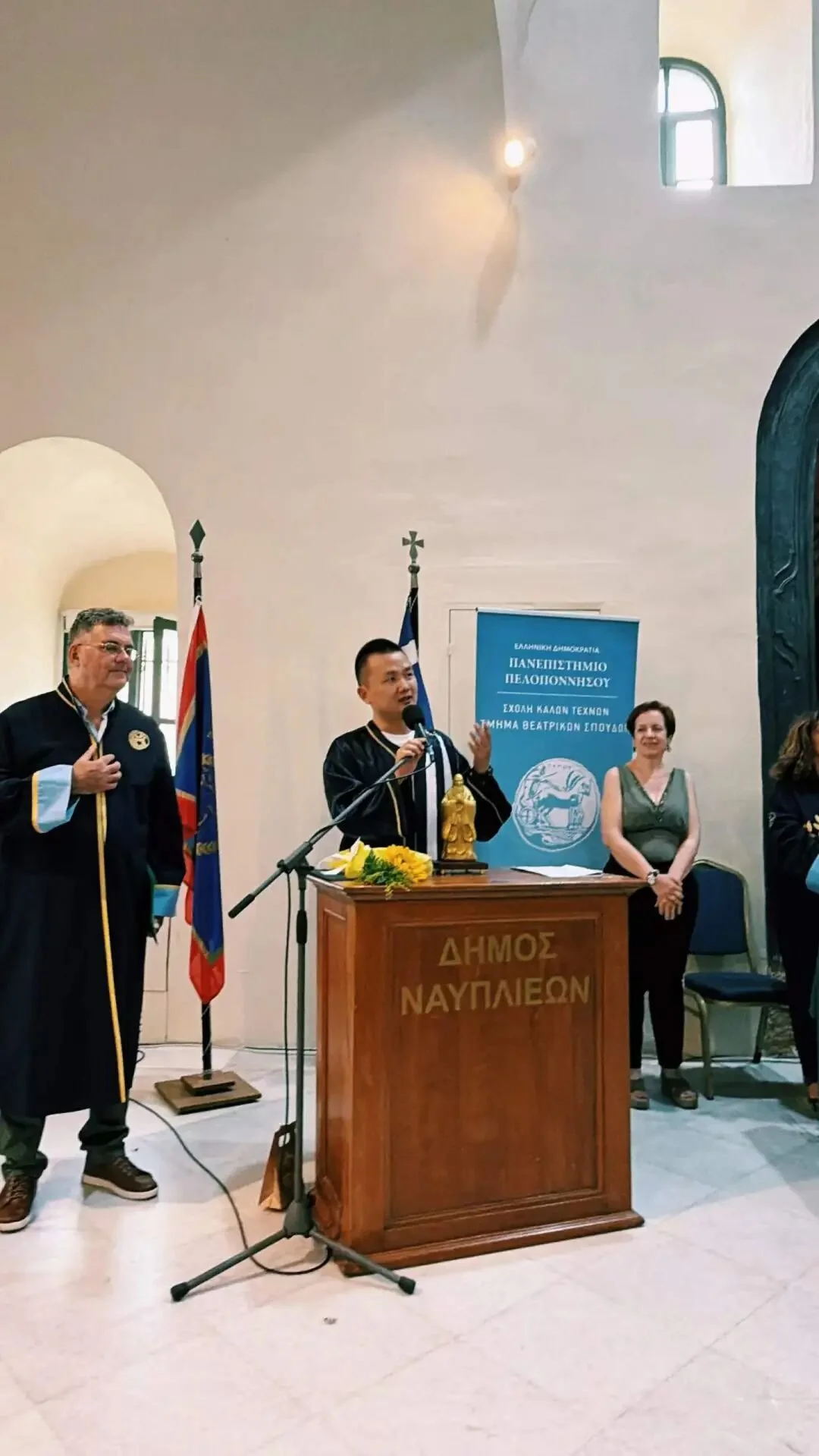
作为希腊伯罗奔尼撒大学(University of Peloponnese)戏剧研究系的博士、国际戏剧教育联盟(IDEA)执行委员会委员,缪斌的学术路径并没有停留在象牙塔的文献里,而是深深扎根于教育的一线现场。
希腊学术渊源
他在希腊伯罗奔尼撒大学戏剧系获得了教育戏剧(Drama in Education)硕士学位,并曾荣获校长授予的“教育戏剧中国大使”称号。日前,他在该校获得教育戏剧博士学位。
国内教育深耕
现任成都天府七中艺术课程中心主任、戏剧教育研究中心主任。他率先将戏剧作为一门独立的必修课引入小学,并在校内搭建了必修、选修、特修的三级戏剧课程体系。
国际组织视野
担任国际戏剧教育联盟(IDEA)项目总监及执行委员会委员,长期活跃于中希文化交流和国际戏剧教育的前沿阵地,还曾受冰岛戏剧教育协会邀请赴冰岛为当地中小学戏剧教师开展培训。
核心教育理念与理论建树
“动作先于语言”的教育哲学
在成都天府七中开展戏剧课程期间,缪斌率先将戏剧作为独立必修课引入校园。他在教学中极力倡导“动作先于语言”的哲学,打破传统以语言台词为主的戏剧教学框架。同时,他强调整体的创作过程大于最终的精英化舞台呈现,将戏剧视作培养同理心和公民责任感的工具。
打通文明的“跨文化漫游支架”
希腊悲剧离中国孩子太远?他通过构建“跨文化漫游支架模型”,巧妙地将古希腊的神话伦理与中国语境相链接。他曾与袁老师带领学生创作英文原创戏剧《火种》(The Spark),并远赴希腊古麦西尼(Ancient Messene)剧场,在两千多年的古老遗址上发出了中国青少年的声音。
从学校到社区的剧场边界拓展
不仅出版了《校园有戏——中小学戏剧教育实践指南》为一线教师提供实操利器,他领衔的“缪斌戏剧教育工作室”还坚持用“教学日志”和学习共同体赋能各地学科教师。此外,他积极打破校园围墙,长期与A4儿童艺术馆跨界合作,让戏剧回归到更广阔的公共空间。
以戏剧赋能乡村教育
多年来,他积极参与到乡村教育支持,为乡村学校和教师带去戏剧教育培训,三四年来,已经在浙江桐浦、河南汝阳、湖南永顺等地生根发芽。
结语:教育的真谛
从希腊大学毕业典礼上那句庄严的誓词,到中国教育者在戏剧教育中的不懈探索,我们看到了一条贯穿东西方的精神暗线:
教育,绝不仅仅是获取一纸文凭和炫耀性的头衔;它是用所学去连接他人、服务社区,并在不断的反思与实践中,完成对“人”的最终塑造。
Why Do Greek University Graduates Lack Graduation Caps and Wear Identical Academic Gowns?
It is that annual graduation season once again. As social media feeds are flooded with "square mortarboards" tossed into the air, did you know that in Greece—the birthplace of Western civilization—university graduates present a completely different scene: no graduation caps, identical robes for all degree levels, and the core highlight of the ceremony being a sacred "oath-taking"?
Today, let us step into the halls of Greek higher education to explore the underlying logic behind this unique tradition and meet the Chinese "wall-breaker" deeply cultivating drama education by the Aegean Sea.
01. Graduation Without Fancy Attire or Academic Caps
In the Anglo-American system, academic regalia for bachelors, masters, and doctoral degrees has extremely strict hierarchical distinctions. However, in Greek public universities, whether you have just completed four years as an undergraduate or endured years of grueling doctoral research, the academic gown (Τήβεννος) worn at the graduation ceremony is typically the exact same style. Schools do not even issue caps at all.
This is not because Greeks are unconcerned with formality, but stems from a profound classical philosophy: before truth and public responsibility, scholars are born equal. In Greek educational philosophy, whether an undergraduate just earning a foundational degree or a doctoral candidate deeply specialized in a specific field, everyone shares the same identity on the path to pursuing truth—a "Scholar." The uniform robe is the visual embodiment of this spirit of academic equality.
The square mortarboard we commonly see today originated from the "biretta" or skullcap worn by Roman Catholic clergy in medieval Western Europe. But Greece had neither the guild-based class divisions of the Middle Ages nor elaborate velvet-trimmed embellishments. In certain historic universities or specific faculties (such as the University of Athens or Aristotle University), schools provide graduates with a simple academic robe (Tivennos, whose color usually represents different disciplines) worn over formal attire, but absolutely no cap.
The design philosophy of Greek university robes (Τήβεννος) leans more toward paying homage to the togas of ancient Greece and Rome. In the classical era, the toga was a symbol of a free citizen.
After the ceremony, some family members and friends crown graduates with a "laurel wreath" woven from olive or laurel branches—a totem symbolizing victory and supreme honor in ancient Greece, far more romantic and solemn than any graduation cap.
02. Graduation Oath-Taking in Greek Universities
Greek graduation ceremonies are not called "Graduation," but rather Ορκωμοσία (Orkomosia), literally translated as "Oath-Taking Ceremony." In Greek educational philosophy, graduation is not a transaction to obtain a piece of paper, but a solemn social contract ceremony. Whether you study medicine, drama, or engineering, you must publicly swear an oath (choosing to do so in the name of religion or personal civic honor): promising to use the knowledge acquired for the betterment of society and the defense of human dignity.
This practice of placing the "oath" at the absolute core of graduation stems primarily from Greece's profound historical perception of knowledge, ethics, and civic responsibility:
The Spiritual Continuation of Ancient Greek Tradition
The tradition of oath-taking is deeply rooted in ancient Greek culture. The most famous example is the Hippocratic Oath, which established the cornerstone of medical ethics; another is the Ephebic Oath, which required ancient Athenian youth, upon completing their military and civic training, to swear to defend the polis and respect the laws.
The oath-taking in modern Greek universities is a modern echo of this spirit. It conveys a core philosophy: knowledge and skills must be constrained by ethics. Individuals equipped with professional expertise—much like youths armed with weapons—must pledge to the community (the polis/society) that they will not use this power for destruction.
The "Social Contract" and Public Nature of Knowledge
The Greek Constitution dictates that public higher education is entirely tuition-free. This means the education of a university student is jointly borne by the state and all taxpayers.
Therefore, the graduation oath is essentially a social contract of gratitude and giving back. The oath typically states explicitly that graduates promise to apply the sciences and arts they have learned to benefit humanity and serve society, rather than merely for personal gain. It is a ritualistic "delivery of results" to society.
Emphasizing "Ethics" over "Academics"
In the Greek academic tradition, education is not merely the imparting of skills, but the shaping of the "human being" (the ancient Greek concept of Paideia). The oath-taking ceremony emphasizes professional ethics. Whether you study drama, education, engineering, or medicine, the oath requires graduates to uphold truth, maintain integrity, and defend human dignity throughout their future careers. It reminds scholars that scholarship without a moral core is hollow and even dangerous.
The Greek university graduation oath is a confirmation of the identity of a scholar. It strips away flamboyant external decorations and uses the power of the most ancient language to demand that every young person stepping out into society face their inner responsibilities and conscience directly.
03. The Hardcore Academic Purgatory of "Easy Entry, Strict Exit"
Earning this laurel wreath is no easy feat. The Greek Constitution guarantees completely free public higher education, but it has also forged an exceptionally rigorous system characterized by "easy entry, strict exit."
The Five/Six-Year "Powerhouse" Programs:
In Greece, undergraduate programs in certain fields like engineering, fine arts, and drama education take a full 5 years (medicine takes 6). Graduates are directly awarded an "Integrated Master's" degree, carrying exceptionally high weight.
The Unbounded Doctoral Purgatory:
Doctoral training in Greece is entirely research-oriented, supervised jointly by a committee of three advisors. There are no large lectures—only a rigorous advisor-responsibility system. There is no "going through the motions" to graduate; candidates must face a rigorous public defense before a panel of seven professors. Only by passing this hurdle do you truly enter the temple of academic peers.
04. The Chinese "Wall-Breaker" in Cross-Cultural Drama
Along this exceptionally rigorous academic path lies an extremely rare and unique group: Chinese scholars pursuing doctoral degrees in drama in Greece. Among them, Miao Bin—who deeply integrates Greek drama education with domestic Chinese foundational education practices—is the most representative explorer in this group, constructing a complete and profound personal ecosystem bridging Greek and Chinese drama education.
As a Ph.D. graduate from the Department of Theatre Studies at the University of the Peloponnese and an Executive Committee Member of the International Drama/Theatre and Education Association (IDEA), Miao Bin’s academic trajectory has not remained confined to ivory-tower literature; rather, it is deeply rooted in the front lines of education.
Greek Academic Roots:
He earned his Master’s degree in Drama in Education from the Department of Theatre Studies at the University of the Peloponnese, and was previously honored by the university's president with the title of "Drama in Education Cultural Ambassador to China." Recently, he earned his doctoral degree in drama education from the same institution.
Domestic Educational Cultivation:
He currently serves as the Director of the Arts Course Center and the Director of챈 the Drama Education Research Center at Chengdu Tianfu Seventh High School. He pioneered the introduction of drama as an independent compulsory course in primary school, establishing a three-tiered curriculum system comprising compulsory, elective, and specialized tracks within the school.
International Organizational Vision:
Serving as a Project Director and Executive Committee Member of IDEA, he has long been active at the forefront of Sino-Greek cultural exchange and international drama education. He was also invited by the Association of Drama Teachers in Iceland to travel to Iceland and conduct training for local primary and secondary school drama teachers.
Core Educational Philosophy and Theoretical Achievements
The Educational Philosophy of "Action Precedes Language":
During his implementation of drama curricula at Chengdu Tianfu Seventh High School, Miao Bin pioneered introducing drama as an independent compulsory course. In his teaching, he strongly advocates for the philosophy of "action precedes language," breaking away from traditional drama teaching frameworks dominated by spoken lines. Simultaneously, he emphasizes that the collective creative process outweighs the final elitist stage presentation, viewing drama as a tool to cultivate empathy and civic responsibility.
Constructing "Cross-Cultural Roaming Scaffolding" to Bridge Civilizations:
Are Greek tragedies too distant for Chinese children? By constructing a "Cross-Cultural Roaming Scaffolding Model," he cleverly links ancient Greek mythological ethics with the Chinese context. Alongside Teacher Yuan, he led students to create the original English play The Spark, traveling far to the ancient theater of Ancient Messene in Greece to make the voices of Chinese youth resonate across ruins over two thousand years old.
Expanding Theater Boundaries from School to Community:
Beyond publishing Campus Drama: A Practical Guide to Drama Education in Primary and Secondary Schools to provide front-line teachers with practical tools, the "Miao Bin Drama Education Studio" he leads persists in empowering discipline teachers across various regions using "teaching logs" and learning communities. Additionally, he actively breaks down campus walls, maintaining long-term cross-disciplinary collaboration with the A4 Children's Art Museum to return drama to broader public spaces.
Empowering Rural Education Through Drama:
Over the years, he has actively participated in rural education support, bringing drama education training to rural schools and teachers. Over the past three to four years, these efforts have taken root in places like Tongpu in Zhejiang, Ruyang in Henan, and Yongshun in Hunan.
Conclusion: The True Meaning of Education
From the solemn oath at Greek university graduation ceremonies to the relentless explorations of Chinese educators in drama education, we witness a spiritual thread running through both East and West:
Education is never merely about acquiring a diploma and ostentatious titles; it is about using what one has learned to connect with others, serve the community, and complete the ultimate shaping of the "human being" through continuous reflection and practice.