
大汗淋漓的20天:我在特佐普洛斯工作坊经历了什么?A Sweaty 20 Days: What I Experienced in the Terzopoulos Workshop
今天是这个月的第二个休息日。终于可以让自己的身体停下来,也终于可以有时间坐下来回顾这过去的二十天。
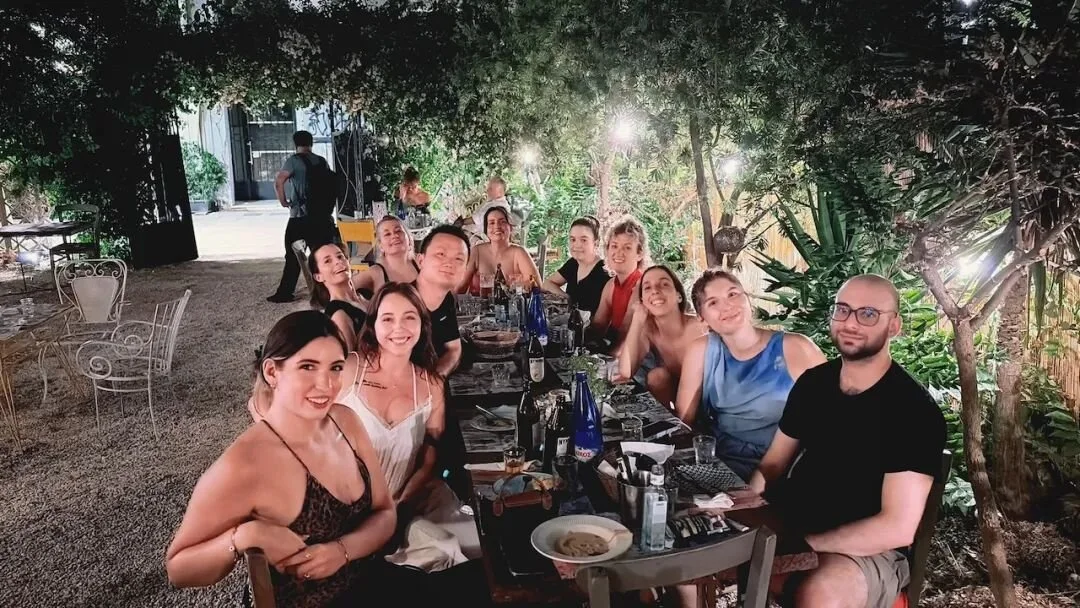
在第一个十天,我们主要学习了corporal training(体能训练)和deconstruction(解构),在第二个十天,我们延续了这两个练习,同时加上了声音练习和台词练习。
这二十天里,我们每天到了剧场的排练室,并无过多寒暄,围成圆,脚掌感受地面,膝盖微屈,双手放在小腹,张开鼻腔口腔,吸气,呼气,练习开始,先是整套的corporal training,然后无缝衔接到声音练习,再无缝衔接到deconstruction。再停下来,就已经两个半小时过去了。我们的身上大汗淋漓,衣服湿透,全身疲惫不堪。说实话,难以相信两个半小时就这样倏忽而过。
接下来有15分钟的休息,我喜欢走到剧场下面的路边台阶那儿休息,呼吸新鲜的空气,看看来来往往的人。但是大家的喜好不同,最开始是我和另外两个土耳其同学和一个俄罗斯同学四个人,后来土耳其同学和俄罗斯同学相继回国,休息的地方从四个人变成两个人最后变成我一个人。我有时候喜欢在休息的时候去对面咖啡馆买杯鲜榨橙汁,补充一下能量。
休息的时间总是感觉很短,回到排练室,我们又开始接下来的练习。第二个十天里增加了文本台词练习,选择了阿提斯剧院经典作品的剧本,欧里庇得斯的《酒神的伴侣》。
特佐普洛斯方法的学习是逐步叠加,所以到了文本台词练习的时候,需要把前面所有的内容都用上。这与我们过去说台词完全不同,而是通过呼吸引起核心的震动,在震动中产生能量,能量传送到身体其他部位。此时说台词,会产生一种特别的力量和节奏。
最后几天里总共进行了三轮文本台词练习,均以每次单人进行。在第一轮的时候,我尚未记忆台词,所以在前面两位希腊同学练习的时候,我特地记了一下他们说的前两句台词:Είμαι ο Διονύσος, παιδί του Δια. Με γέννησε η Σεμελη, κόρη του Κάδμου。当轮到我的时候,我跟老师说,我就说希腊语。应该说,我学习特佐普洛斯方法有个优势就是本身会腹式呼吸,所以在说台词的时候也比较容易找到感觉。另外我在之前的deconstruction练习中效果也不错,所以为台词练习打好了基础。当我开始用希腊语说的时候,同学们都愣了一下。实际上几年前我在埃皮达夫罗斯戏剧训练营的时候,也是用希腊语练习和演出,所以比较清楚希腊语台词的感觉。
经过几次练习之后,还是存在不少问题,我都立即在本子上记录下来。不过我听到Tasos说了一句καλά(好),这让我更有信心了。不过,老师还是建议我使用中文,这样在说台词的时候不用特别去想台词,因为特佐普洛斯方法里对台词并不会放在特别重要的地位,更重视的仍然是呼吸和身体。
第二天我把中文台词背诵了,不过还是比较担心用中文会不会没有感觉。因为过去几年里我看了很多希腊戏剧,希腊语有一种特别的节奏,在演出戏剧的时候会产生一种特别的韵味。而用中文去演出古希腊戏剧,会不会奇怪?我向老师提出了这个问题,他说应该没有问题,特佐普洛斯方法使用各种语言都可以。
第二天并没有轮到我,第三天,我第一个举手。这是我第一次将这些天的训练加上台词,还是有点激动的。结果导致了我说台词语速特别快,呼吸节奏也变乱了。不过用中文奇怪的问题似乎没有很明显。我将老师的建议记录下来,然后继续观察其他同学的练习。
第三次练习是在最后一天,我依然是第一个。这几天里我常常记忆台词,并且练习,在走去剧场的路上,我也边走边练习。结果非常不错,我站好后,从呼吸开始,慢慢加上核心的震动,先发a来试音,全身放松,等状态调整好,我开始说台词。第一遍的效果还可以,不过似乎还没有达到一个更理想的状态。于是我进行第二遍,这一遍我完全进入了状态,核心、脊柱、呼吸、声音都调动了起来,我将整段台词都说完了。后来晚上聚餐的时候,一位同学说,当我说最后一段的时候,虽然他们听不懂我在说什么,但是那种感觉瞬间吸引了他们,感觉很震撼。
当然,这还只是我的初尝试。接下来的第三个十天,我们将从“身体”“身体+声音”进行到“无限即兴”。老师说,在即兴中会将我们前面两个阶段所有的内容都用上。我很好奇,在特佐普洛斯方法里的即兴是怎样的。因为在我的戏剧教育里,我也非常重视即兴,而这是在过去很多戏剧教学、表演教学里被严重忽视的。老师示范、学生模仿,最后导致的就是千篇一律、丧失想象。戏剧的魅力,或者说艺术的魅力,正是在于即兴,而即兴就是创造。
从1986年特佐普洛斯导演《酒神的伴侣》(Bacchae),他与演员们通过一次次的即兴探索出了一种新的戏剧——酒神戏剧。这种戏剧形式重视身体,期望演员通过一系列训练找回本初的身体。这与铃木忠志《文化就是身体》的观念不谋而合。实际上,在世界最顶级的戏剧大师,无不重视身体,而非单纯的语言。甚至特佐普洛斯认为“台词常常扰人”,“文本有了身体的维度,成为不同行动和行为的地图”。他认为文本需要被消解,经过重构,“才重新对表演者受心理影响的的行为有了意义”。这正是我这些年逐步形成的戏剧教育理念中同样坚持的,肢体是戏剧的核心,并且文本需要被解构和重构。
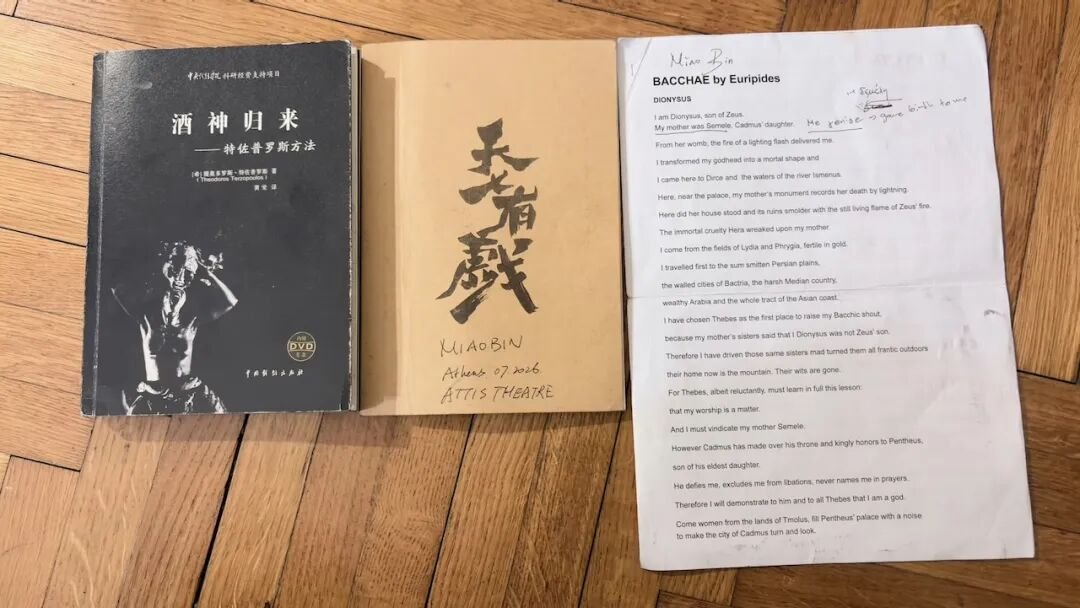
我将特佐普洛斯的《酒神归来》这本书已经翻了很多遍,每个字句都认真反复看,尤其是在每天学习的同时,感受与参加工作坊学习之前完全不同。让我很受鼓舞的是,我从书中找到不少印证我自己戏剧教育理念的内容,这让我更有信心去坚持自己的观点。
特佐普洛斯长期以来导演的大多都是古希腊戏剧,他成为了这个领域在当代独一无二的引领者。过去几年里尽管我看过不少他导演的演出,却从未想过自己也能有机会来学习他的方法。
当然,我学习特佐普洛斯方法并非为了让自己成为演员,尽管在这段时间的学习中,两位导师都对我的表现赞赏有加,我自己也能感觉这二十天里我的身上已经发生了巨大的变化,但是我的目标并非自己当演员,而是希望从特佐普洛斯方法中去提取和创生出对戏剧教育有用的材料,从而继续改进和丰富我自己戏剧教育的理念和方法。事实上,在二十天过去,我已经找到了不少有用的材料。
与我一起学习的基本上都是戏剧演员,似乎来参加这样一个表演训练不适合面向儿童的戏剧老师。其实并不是,因为我的观点是,戏剧老师必须懂戏剧。哪怕你过去并非戏剧专业,也没有演出过戏剧,但是只要你选择从师戏剧教育行业,你必须要懂戏剧。戏剧在这里并非只是那些简单的戏剧游戏或者戏剧习式,而是真正的戏剧艺术。这也是大卫·戴维斯曾经批判过的问题,就是不懂戏剧而去教戏剧课。我自己过去也并非戏剧专业出身,但是当我开始学习戏剧教育的时候,我立即意识到学习戏剧艺术的重要性,于是就在雅典的希腊艺术剧院拜师学艺,开始跑各个剧组,开始去大量地看剧,开始把关于戏剧的书都去读。所以,如果你想成为一名中小学戏剧教师,可以先看一下自己在这方面已经做了哪些。
所以,懂教育而不懂戏剧,或者懂戏剧而不懂教育,都无法做戏剧教育。
在希腊有一句话,戏剧自诞生之日起就有教育功能。在古希腊,戏剧起着公民教育的作用。所以,在希腊不会出现把戏剧纯粹当作娱乐的情况,戏剧艺术家们也都有着深厚的文学底蕴。翻看《酒神归来》这本书,正如前言作者Eleni Varopoulou缩写,特佐普洛斯的文风既有精确务实的一面,又有哲学抽象的一面。确实,在读这本书的时候,会有一种在读哲学书的错觉。或许特佐普洛斯就是在当哲学书来写,或者他就是认为哲学与戏剧本就是一体。
所以,戏剧教育者,必须要有良好的文学底蕴和哲学功底。要知道,戏剧的境遇中探索的就是两难,若无哲学功底,那如何能够理解呢。
A Sweaty 20 Days: What I Experienced in the Terzopoulos Workshop
Today is the second rest day of the month. I can finally let my body pause and take the time to sit down and review these past twenty days.
During the first ten days, we primarily focused on corporal training and deconstruction. In the second ten days, we continued these exercises while adding voice and text delivery training.
Over these twenty days, upon arriving at the studio rehearsal room each day, there was no excessive small talk. We formed a circle, felt the soles of our feet against the ground, slightly bent our knees, placed our hands on our lower abdomens, opened our nasal and oral cavities, inhaled, and exhaled. The training began with the complete set of corporal training, transitioned seamlessly into voice exercises, and then flowed effortlessly into deconstruction. Before we knew it, two and a half hours had passed. We were drenched in sweat, our clothes soaked through, and our entire bodies utterly exhausted. To be honest, it was hard to believe that two and a half hours had flown by just like that.
Next came a 15-minute break. I liked to walk over to the steps by the road outside the theater to rest, breathe in the fresh air, and watch the passersby. Everyone had different preferences; initially, it was four of us—myself, two Turkish classmates, and a Russian classmate. Later, the Turkish and Russian classmates returned to their home countries one after another, and the resting group went from four people to two, and finally down to just me. Sometimes during the break, I liked to head to the café across the street to buy a cup of freshly squeezed orange juice to recharge.
Break time always felt brief. Returning to the rehearsal room, we resumed our practice. The second ten days introduced text delivery exercises, utilizing the script from a classic Attis Theatre production, Euripides' Bacchae.
Learning the Terzopoulos method is a process of progressive accumulation, so by the time we reached text delivery, all previous elements had to be brought into play. This was completely different from how we traditionally deliver lines; instead, core vibrations are triggered through breathing, generating energy that is transmitted to other parts of the body. Delivering lines at this point produces a special kind of power and rhythm.
Over the final few days, we conducted a total of three rounds of text delivery practice, each performed individually. During the first round, I hadn't memorized the lines yet, so while the first two Greek classmates practiced, I deliberately jotted down the first two lines they spoke: Είμαι ο Διονύσος, παιδί του Δια. Με γέννησε η Σεμελη, κόρη του Κάδμου. When my turn came, I told the instructor that I would speak in Greek. To be fair, one advantage I had in learning the Terzopoulos method was that I already practiced abdominal breathing, making it easier to find the right feel when delivering lines. Additionally, my performance in the preceding deconstruction exercises had gone quite well, which laid a solid foundation for the text work. When I started speaking in Greek, my classmates were momentarily stunned. In fact, a few years ago during my time at the Epidaurus Lyceum training camp, I had also practiced and performed in Greek, so I had a relatively clear sense of Greek text delivery.
After a few practices, there were still quite a few issues, which I immediately recorded in my notebook. However, hearing Tasos say "καλά" (good) gave me an extra boost of confidence. Nevertheless, the instructor suggested that I use Chinese, so that I wouldn't have to deliberately think about the lines while speaking. In the Terzopoulos method, text is not placed in an overwhelmingly dominant position; breathing and the body are valued far more.
The next day, I memorized the Chinese text, though I remained somewhat concerned about whether using Chinese would cause me to lose the desired feeling. Having watched many Greek plays over the past few years, Greek possesses a unique rhythm that creates a distinctive charm during theatrical performance. Would performing ancient Greek drama in Chinese feel strange? I raised this question with the instructor, and he replied that it should be fine—the Terzopoulos method can be applied using any language.
It wasn't my turn the following day. On the third day, I raised my hand first. This was my first time combining the training of these past few days with text delivery, and I was still a bit excited. Consequently, my delivery speed was particularly fast, and my breathing rhythm became disordered. Yet, the issue of Chinese feeling "strange" didn't seem very noticeable. I noted down the instructor's advice and continued observing my classmates' practices.
The third practice took place on the final day, and I was once again the first to go. Over the past few days, I had frequently memorized and practiced the lines, even rehearsing while walking to the theater. The result was exceptional. Once in position, starting from the breath, I gradually added core vibration, testing the sound with an initial "a," relaxing my entire body, and once my state was adjusted, I began speaking the lines. The first run went decently, though it didn't quite reach an ideal state. Therefore, I performed a second run. This time, I entered the state completely—core, spine, breath, and voice were all mobilized, and I delivered the entire passage. Later that evening during dinner, a classmate remarked that when I spoke the final section, although they didn't understand the words, the sheer feeling instantly captivated them, creating a deeply impactful experience.
Of course, this was merely my initial attempt. In the upcoming third ten-day block, we will progress from "body" and "body + voice" to "infinite improvisation." The instructor noted that improvisation will draw upon everything we learned in the previous two stages. I am very curious about what improvisation looks like within the Terzopoulos method. In my own journey with drama education, I also place a heavy emphasis on improvisation—something that has been severely neglected in many traditional drama and acting teaching methods. When instructors simply demonstrate and students merely imitate, the ultimate result is uniformity and the loss of imagination. The charm of drama, or rather the charm of art, lies precisely in improvisation, and improvisation is creation.
Ever since director Theodoros Terzopoulos staged Bacchae in 1986, he and his actors have explored and forged a new form of theater—Dionysian theater—through continuous improvisation. This theatrical form prioritizes the body, expecting actors to recover their primordial physical state through a series of training regimens. This coincides seamlessly with Tadashi Suzuki's concept that "culture is the body." In fact, all of the world's top master-level theater practitioners place immense importance on the body rather than relying solely on language. Terzopoulos even believes that "lines are often intrusive," and that "when text acquires a physical dimension, it becomes a map of different actions and behaviors." He asserts that text must be deified, deconstructed, and reconstructed "before it regains meaning for the performer's psychologically influenced behavior." This aligns precisely with the drama education philosophy I have gradually formed and firmly uphold over the years: the physical body is the core of drama, and text must be deconstructed and reconstructed.
I have thumbed through Terzopoulos's book The Return of Dionysus countless times, carefully reading every sentence and phrase, especially while studying daily. The experience is entirely different from what it felt like before attending this workshop. What greatly encouraged me was finding numerous passages in the book that corroborate my own drama education philosophy, giving me even greater confidence to persist in my views.
Terzopoulos has long directed predominantly ancient Greek drama, making him a unique contemporary leader in this field. Despite having watched many of his directed productions over the past few years, I never imagined I would have the opportunity to study his methods firsthand.
Of course, learning the Terzopoulos method is not about turning myself into an actor. Even though both mentors praised my performance during this period, and I could personally feel the massive transformation my body underwent over these twenty days, my goal is not to become an actor myself. Rather, it is to extract and generate useful materials from the Terzopoulos method to continuously refine and enrich my own drama education philosophy and methodology. In fact, now that the twenty days have passed, I have already gathered plenty of valuable material.
Most of my fellow learners were professional actors, which might make it seem like participating in such an acting training program is unsuited for a drama educator working with children. In reality, that is far from the case, because my firm belief is that a drama teacher must understand theater. Even if your background is not in theater and you have never performed on stage, the moment you choose to enter the drama education profession, you must understand theater art. Theater here is not merely simple drama games or conventions, but true theatrical art. This is precisely the issue David Davis once criticized—teaching drama classes without understanding theater. My own background was not originally in theater either, but when I began studying drama education, I immediately realized the importance of mastering theatrical art. Consequently, I apprenticed at the Greek Art Theatre in Athens, frequented various theater troupes, watched massive amounts of plays, and read every book on theater I could find. Therefore, if you wish to become a primary or secondary school drama teacher, you can start by examining what you have already done in this regard.
Thus, understanding education without understanding theater, or understanding theater without understanding education, makes it impossible to truly practice drama education.
There is a saying in Greece that theater has possessed an educational function since its inception. In ancient Greece, theater served the role of civic education. Therefore, you do not find instances in Greece where theater is treated purely as shallow entertainment, and theatrical artists likewise possess profound literary foundations. Flipping through The Return of Dionysus, as noted in the preface by translator/writer Eleni Varopoulou, Terzopoulos's writing style is simultaneously precise and pragmatic, yet philosophically abstract. Indeed, while reading this book, one has the illusion of reading a work of philosophy. Perhaps Terzopoulos wrote it intending it as a philosophy book, or perhaps he believes that philosophy and theater are inherently one and the same.
Therefore, a drama educator must possess a solid literary foundation and sound grounding in philosophy. One must remember that dramatic situations explore human dilemmas; without a philosophical foundation, how can one truly comprehend them?